
Electrical Panels in Egypt: Why Factory Power Safety Starts at the Panel
Electrical panels decide how power is distributed, protected, isolated, and maintained inside a factory. A good panel setup helps engineers control faults. A poor setup turns every electrical issue into confusion, risk, and downtime.
Product focus
Electrical panels, protection systems, and industrial distribution materials
Questions this article answers
Why are electrical panels important for factory safety?
What should an Egyptian factory check before buying electrical panels?
How do power distribution panels reduce downtime?
The panel is the control point of factory power
In many factories, electrical problems are not caused by one machine alone. They come from unclear distribution, weak protection, overloaded circuits, poor labeling, or difficult isolation. The electrical panel is where these risks either become controlled or become expensive.
A well-planned panel makes power flow easier to understand. It gives operators and maintenance teams a clear place to switch, isolate, protect, and troubleshoot loads without guessing.
Why panels matter for safety and uptime in Egypt
Factories in Egypt often operate in demanding conditions: dust, heat, expansion pressure, tight production schedules, and mixed equipment from different suppliers. The panel must be designed for real site conditions, not only for a clean drawing.
Good panels reduce unsafe improvisation. They make it easier to isolate a fault, protect equipment, and keep the rest of the plant running when one area needs maintenance.
What buyers should review before approving a panel
Before approving an electrical panel, buyers should review the load list, protection devices, short-circuit rating, enclosure, cable entry, labeling, ventilation, maintenance access, and future spare capacity. A panel with no room for expansion can become expensive quickly.
Procurement should not evaluate the panel only as a metal box with components. It is a safety and reliability system that affects operators, maintenance teams, equipment life, and production planning.
How Atta connects panels with wider industrial supply
Atta Group's electrical supply conversation can connect panels with transformers, electrical materials, overhead transmission-line materials, contracting support, and maintenance needs. This helps the buyer think about power as a system instead of disconnected purchases.
For contractors and factories in Egypt, that matters because electrical infrastructure is usually built in stages. The best panel decision is the one that supports today's load while leaving a clean path for tomorrow's additions.
Panel details that separate a quote from a technical solution
A useful panel discussion should include feeder count, load type, protection coordination, short-circuit level, enclosure rating, cable routing, ventilation, labeling, spare capacity, and the shutdown method for maintenance. These details decide whether the panel will be easy to operate under pressure.
When those details are missing, the buyer may receive a price but not a reliable system. That is the difference between buying a panel and planning industrial power distribution.
Panel design starts with load behavior
An electrical panel should be designed around how loads actually operate. A production line with motors, heaters, drives, compressors, and lighting needs different protection thinking from a simple distribution board.
Before selecting a panel, buyers should clarify current ratings, diversity, starting conditions, fault levels, control needs, metering, cable entry, spare feeders, and whether the panel must support future process changes.
Protection coordination prevents small faults from becoming plant shutdowns
Protection devices should be coordinated so the nearest suitable device clears the fault instead of taking down a larger part of the factory. This is one reason panel design cannot be reduced to a cabinet and breakers.
Coordination affects uptime, safety, troubleshooting speed, and the maintenance team's ability to isolate one area without disturbing unrelated production lines.
Internal layout affects heat, service, and safety
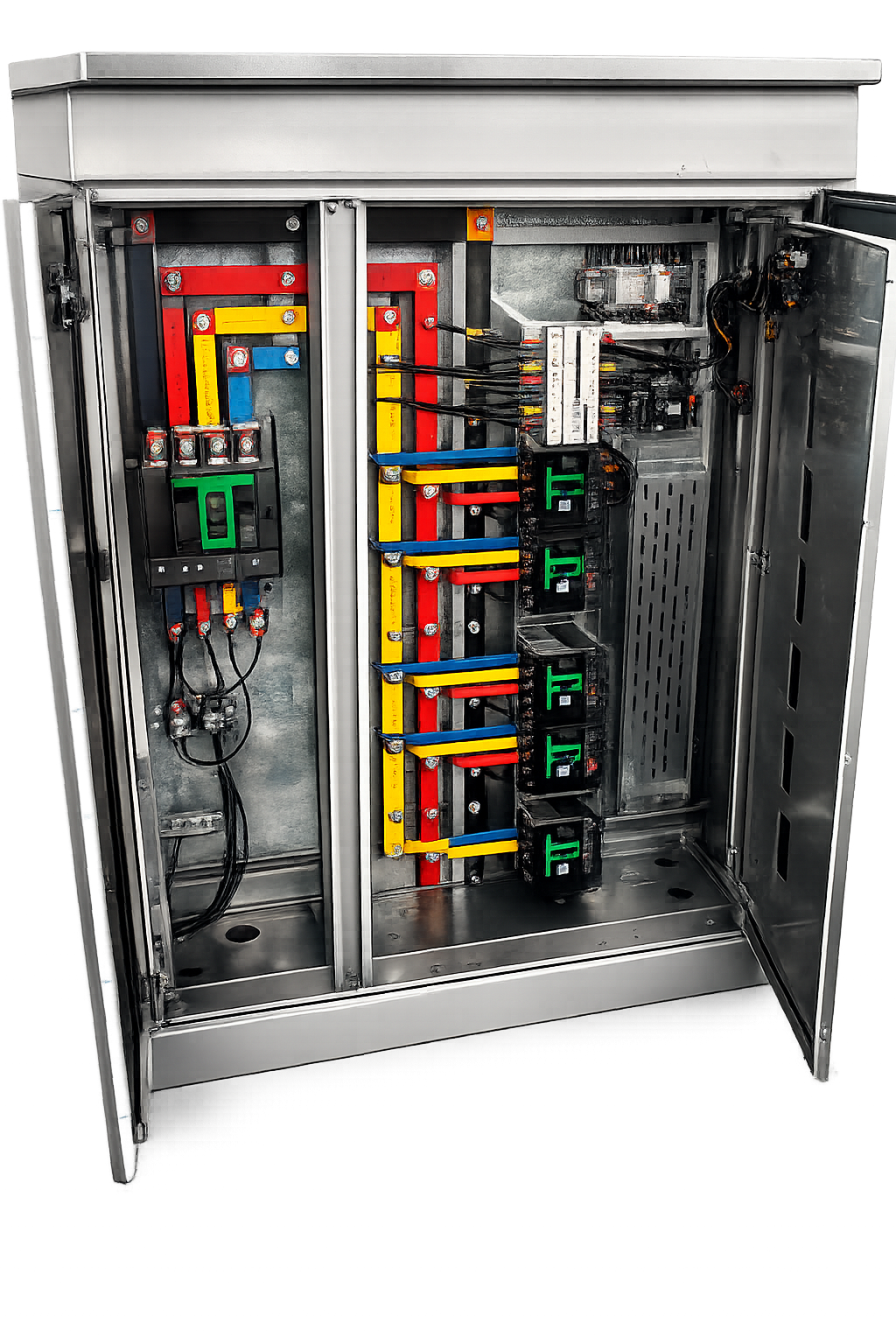
A neat internal layout is not only cosmetic. Busbar arrangement, cable bending space, gland plate position, segregation, ventilation, labeling, and access all affect how safely the panel can be installed and maintained.
Poor layout can create heat concentration, difficult terminations, unclear isolation, and longer repair times. These are technical risks even when the panel looks acceptable from the outside.
What to ask before approving a panel offer
Before approving a panel offer, ask for the scope, standards basis, breaker details, busbar rating, enclosure rating, metering, control components, drawings, cable entry direction, spare ways, testing method, and delivery assumptions.
This helps procurement compare technical quality. A lower price may exclude details that later become site delays, rework, or weak maintainability.
FAQ
Direct answers for buyers and AI search results
Why are electrical panels important in factories?
Electrical panels are important because they organize distribution, protection, switching, and fault isolation. A clear panel setup helps a factory reduce electrical risk, protect machines, and respond faster during maintenance or breakdowns.
What should a factory check before buying an electrical panel in Egypt?
A factory should check the load list, protection devices, enclosure, cable entry, short-circuit rating, labeling, ventilation, maintenance access, and spare capacity for future expansion.
Can better electrical panels reduce downtime?
Yes. Better panels can reduce downtime by making faults easier to isolate and by protecting equipment from avoidable electrical stress. They also help maintenance teams work faster and more safely.
Are electrical panels only needed for new factories?
No. Existing factories may need panel upgrades when they add machines, increase production load, face repeated trips, or need safer maintenance access. Panel improvement can be part of a wider reliability plan.
What makes an industrial electrical panel reliable?
A reliable panel has correct ratings, coordinated protection, clear layout, proper ventilation, good labeling, safe cable access, test documentation, and enough spare capacity for realistic changes.
Why do panel drawings matter before manufacturing?
Panel drawings reveal breaker arrangement, cable entry, metering, control logic, spare feeders, and service access. Reviewing them early prevents expensive site corrections.
Talk to sales
Does this match a need inside your facility?
Share the supply scope or technical issue, and Atta can discuss the right path for transformers, panels, gas systems, or site support.